Microsoft
Wasp supports Microsoft Authentication out of the box.
Microsoft Auth uses Microsoft Entra ID as the identity provider. This lets your users sign in with their Microsoft accounts — including personal Microsoft accounts, work/school (Microsoft 365) accounts, or both, depending on your configuration.
Let's walk through enabling Microsoft authentication, explain some of the default settings, and show how to override them.
Understanding tenants
When setting up Microsoft Authentication, you'll encounter the concept of "tenants". A tenant represents an organization in Microsoft Entra ID. Depending on the supported account types you choose during app registration, your app will be associated with a specific tenant, or be multi-tenant.
When planning out your Microsoft integration, you have to decide which kind of accounts will be able to sign in. This will determine the tenant ID you use in your configuration, and the users that can sign in to your app.
| Supported Account Types | Tenant ID Value | Description | Best for |
|---|---|---|---|
| Tenant-specific | Your Tenant ID (generated by Microsoft) | Only users in your Microsoft Entra ID tenant can sign in. | Internal-only apps for a specific organization. |
| Organization accounts | organizations | Any user with a "work or school" Microsoft account can sign in, but not personal accounts. | B2B apps targeting users in other organizations. |
| Personal accounts | consumers | Only personal Microsoft accounts (e.g., Outlook.com, Hotmail, Xbox) can sign in. | Consumer-facing apps targeting individual users. |
| All of the above | common | Both organizational accounts and personal Microsoft accounts can sign in. | Apps that can be used by personal, work, and school accounts. |
We recommend choosing the least-permissive option that fits your use case, as Microsoft might require you to submit to a verification process if you want to use the higher-privileged tenant types in production.
Setting up Microsoft Auth
Enabling Microsoft Authentication comes down to a series of steps:
- Enabling Microsoft authentication in the Wasp file.
- Adding the
Userentity. - Creating a Microsoft Entra ID app registration.
- Adding the necessary Routes and Pages
- Using Auth UI components in our Pages.
Here's a skeleton of what our main.wasp.ts should look like after we're done:
import { app, page, route } from "@wasp.sh/spec"
import { LoginPage } from "./src/pages/auth" with { type: "ref" }

// Configuring the social authentication
export default app({
  name: "myApp",
  wasp: { version: "^0.25" },
  title: "My App",
  head: ["<link rel='icon' href='/favicon.ico' />"],
  auth: {
    // ...
  },
  spec: [
    // Defining routes and pages
    route("LoginRoute", "/login", page(LoginPage)),
  ],
})
1. Adding Microsoft Auth to Your Wasp File
Let's start by properly configuring the Auth object:
import { app } from "@wasp.sh/spec"

export default app({
  name: "myApp",
  wasp: { version: "^0.25" },
  title: "My App",
  head: ["<link rel='icon' href='/favicon.ico' />"],
  auth: {
    // 1. Specify the User entity (we'll define it next)
    userEntity: "User",
    methods: {
      // 2. Enable Microsoft Auth
      microsoft: {}
    },
    onAuthFailedRedirectTo: "/login"
  },
  // ...
})
userEntity is explained in the social auth overview.
2. Adding the User Entity
Let's now define the auth.userEntity entity in the schema.prisma file:
// 3. Define the user entity
model User {
  id Int @id @default(autoincrement())
  // Add your own fields below
  // ...
}
3. Creating a Microsoft Entra ID App Registration
To use Microsoft as an authentication method, you'll first need to register an application in the Microsoft Entra ID portal and provide Wasp with your client ID, client secret, and tenant ID.
-
Go to the Microsoft Entra ID portal. Login or sign up if necessary.
-
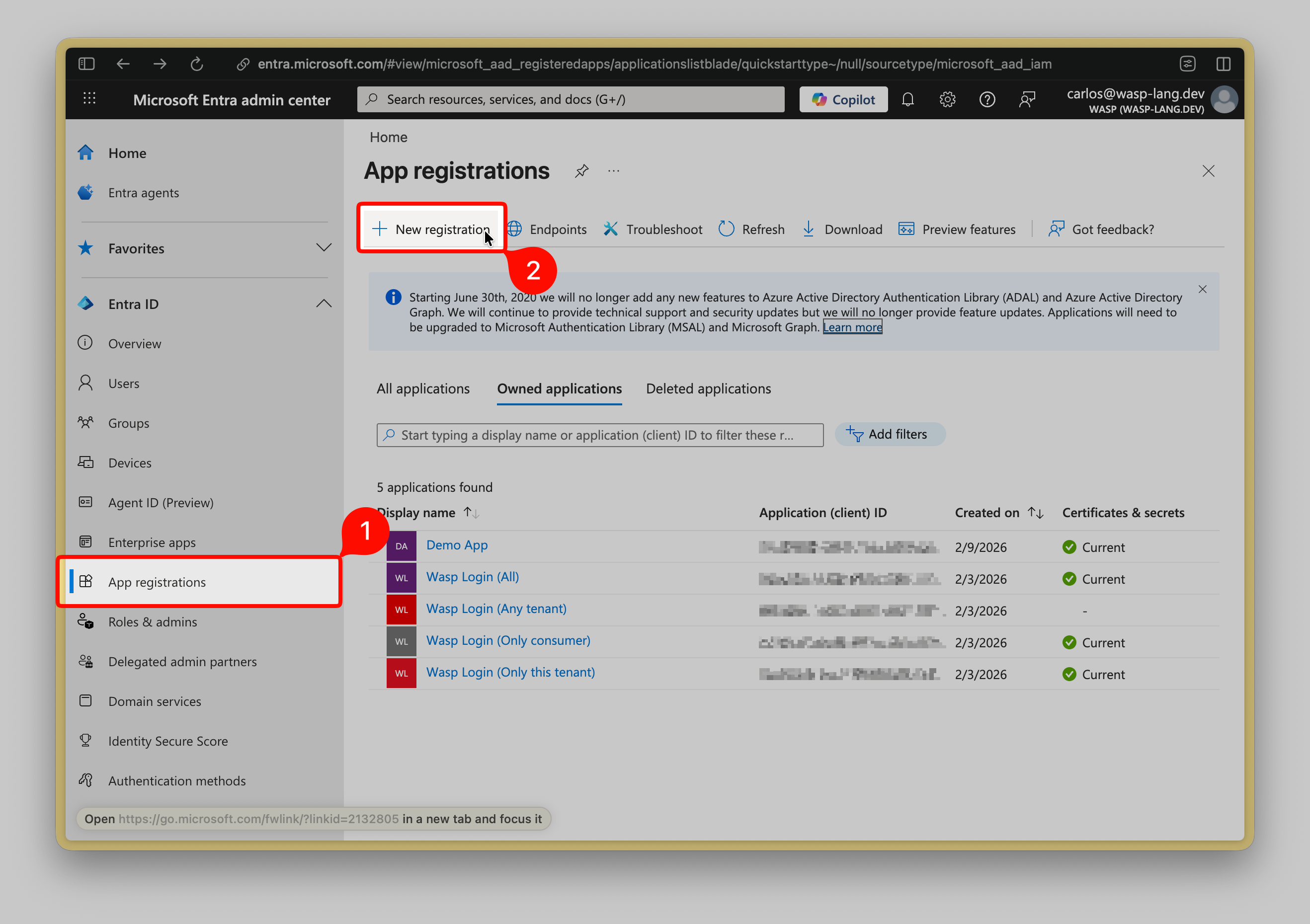
In the left sidebar, click on "App registrations" (1) and then "New registration" (2).
-
Fill out the form. These are the values for a typical Wasp application:
# Field Value 1 Name (your wasp app name) 1 Supported account types Read through Understanding tenants 3 Authorized redirect URIs Web: http://localhost:3001/auth/microsoft/callbacknoteOnce you know on which URL(s) your API server will be deployed, also add those URL(s) in the Authentication section.
For example:https://your-server-url.com/auth/microsoft/callback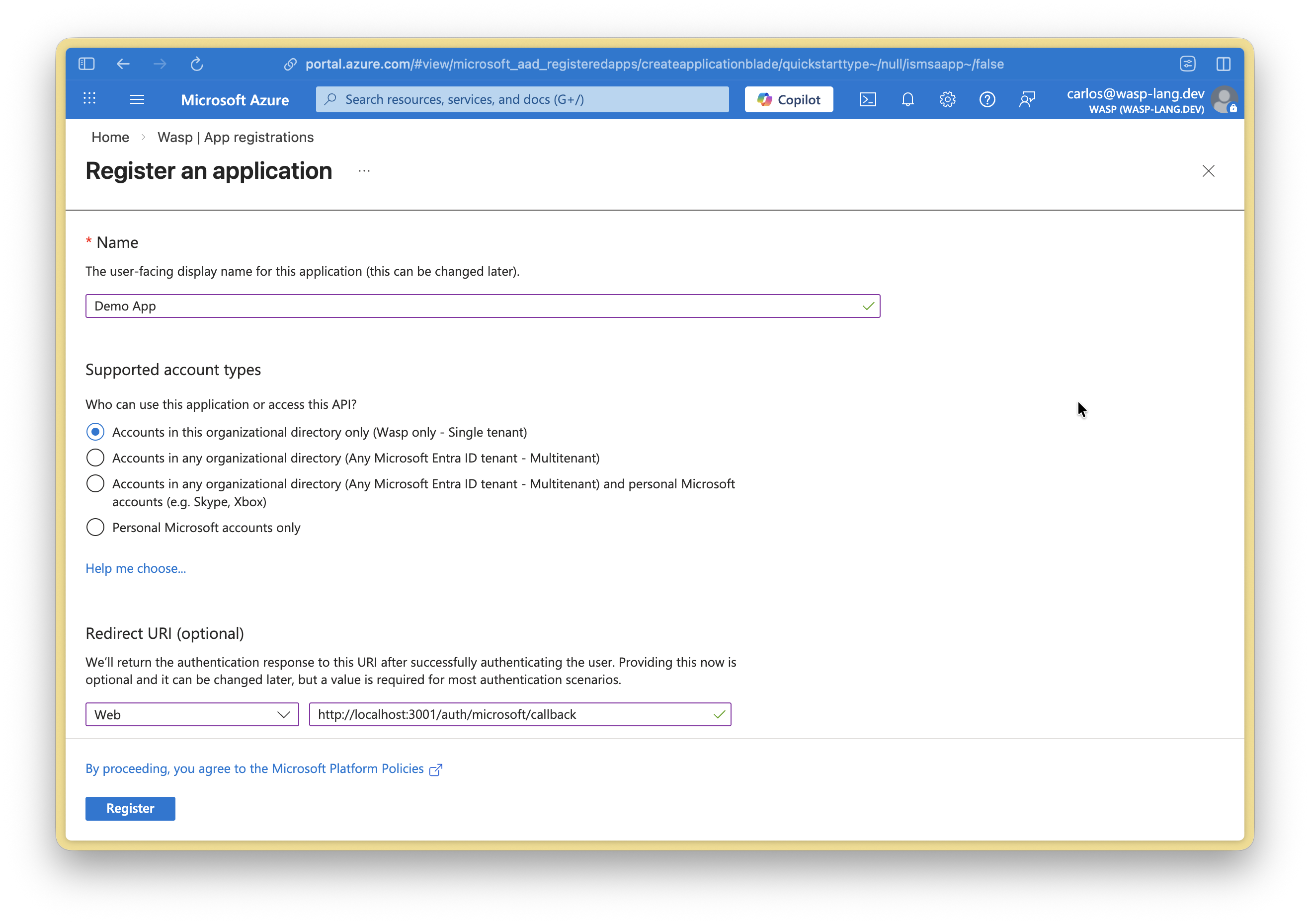
-
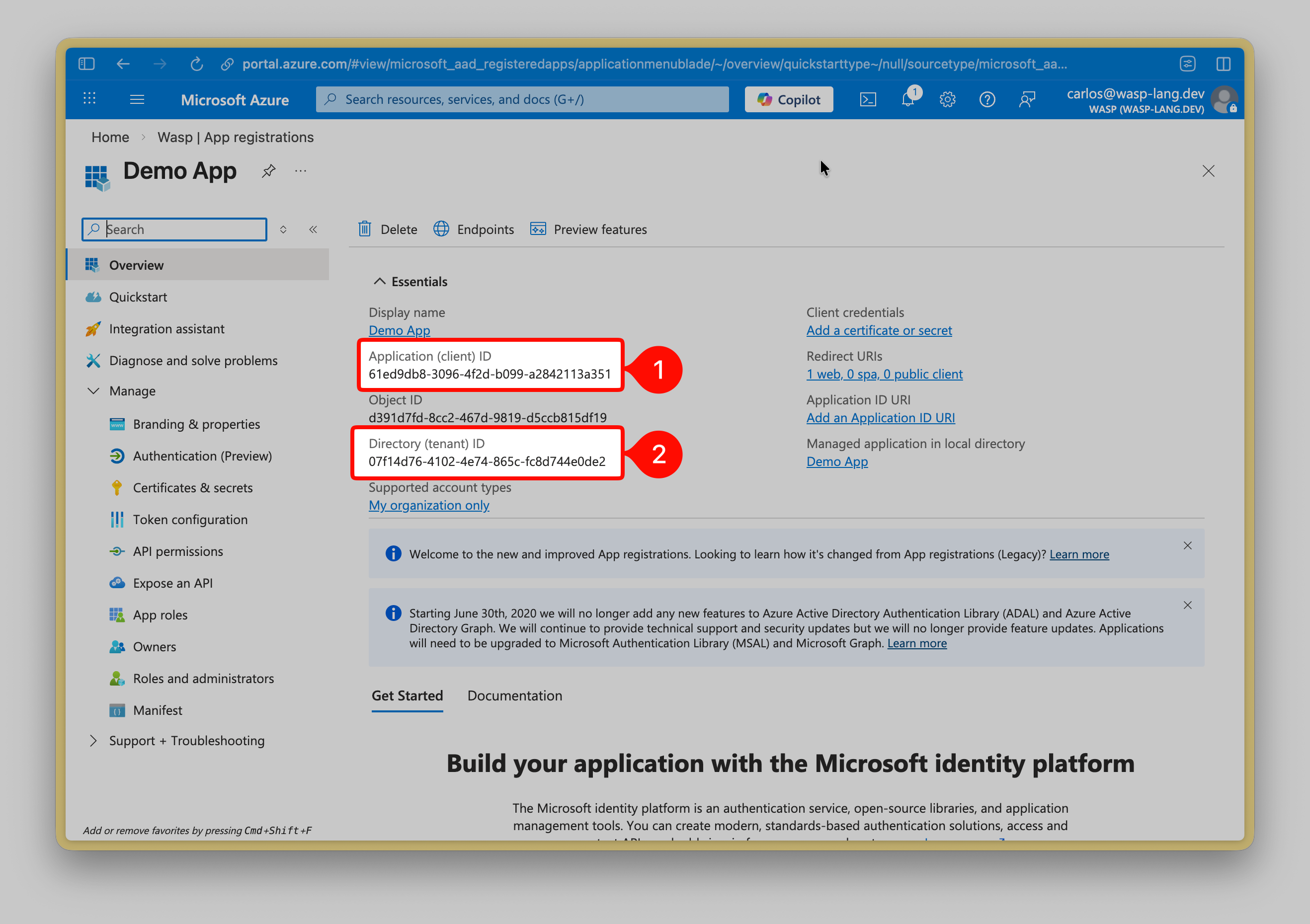
You should now see your app registration's overview page. Take note of the Application (client) ID (1) and the Directory (tenant) ID (2), as you'll need them in the next steps.
-
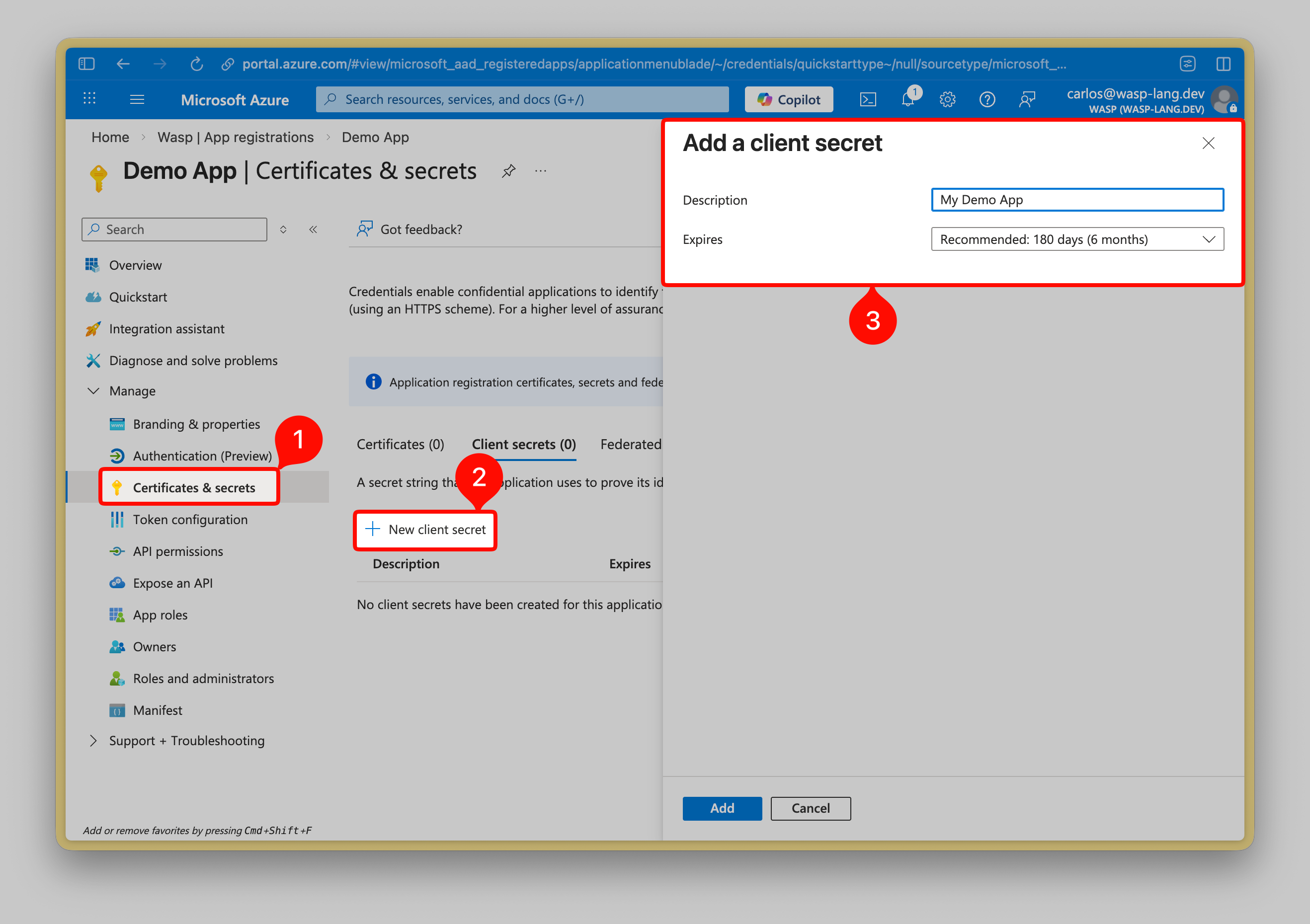
Next, go to the "Certificates & secrets" (1) page from the left sidebar, and create a new client secret (2). You can fill out the name of your Wasp app as the client secret's name (3).
-
Finally, take note of the client secret's value, as you'll need it in the next steps. Make sure to copy it somewhere safe, as you won't be able to see it again!
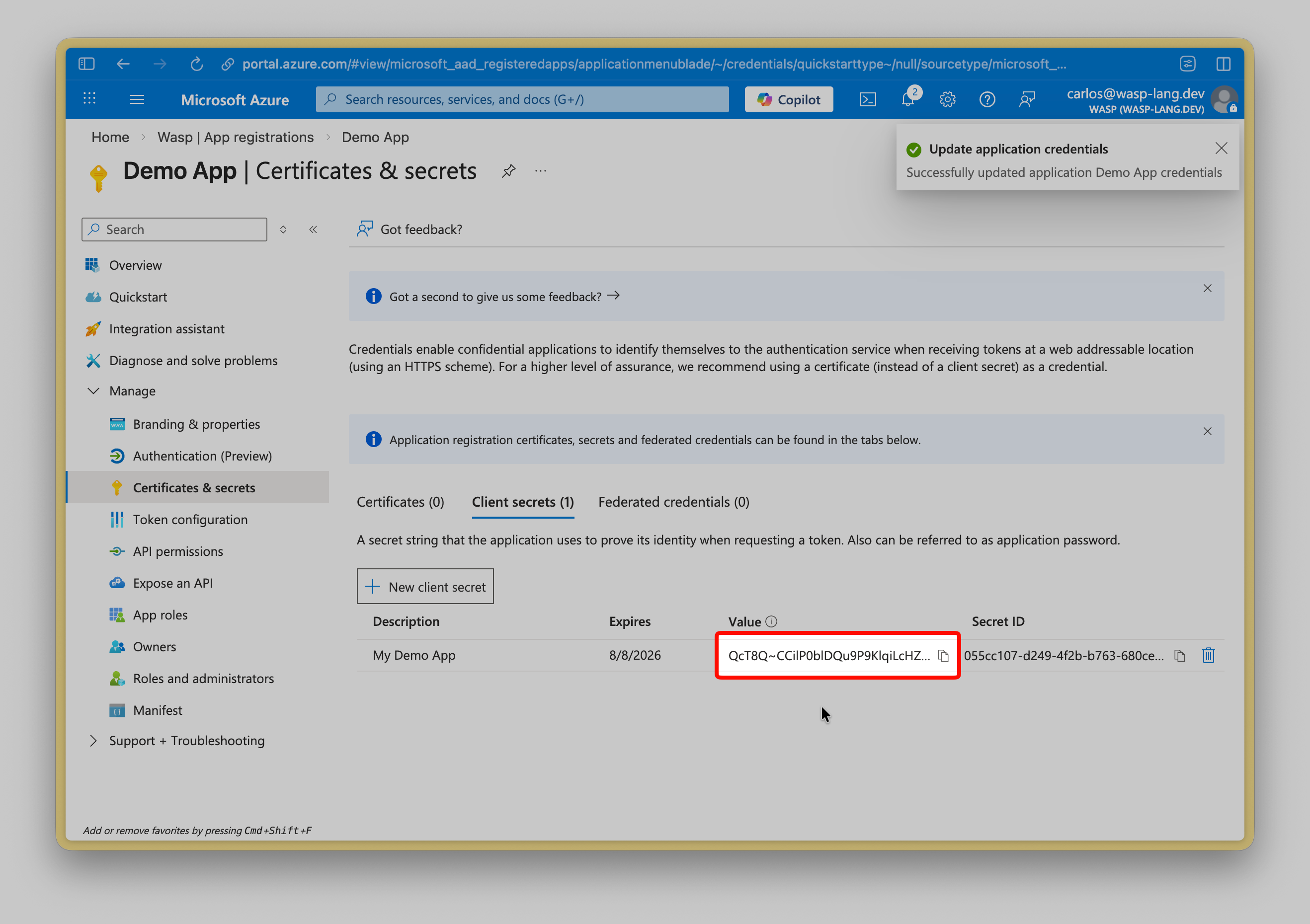
The keys you copied are the credentials your app will use to authenticate with Microsoft. Do not share them anywhere publicly, as anyone with these credentials can impersonate your app and access user data.
4. Adding Environment Variables
Add these environment variables to the .env.server file at the root of your project (take their values from the previous step):
MICROSOFT_TENANT_ID=your-microsoft-tenant-id
MICROSOFT_CLIENT_ID=your-microsoft-client-id
MICROSOFT_CLIENT_SECRET=your-microsoft-client-secret
The MICROSOFT_TENANT_ID should be set based on the supported account types you chose, as described in the Understanding Tenant IDs section above.
5. Adding the Necessary Routes and Pages
Let's define the necessary authentication Routes and Pages.
Add the following code to your main.wasp.ts file:
import { app, page, route } from "@wasp.sh/spec"
import { LoginPage } from "./src/pages/auth" with { type: "ref" }

export default app({
  // ...
  spec: [
    route("LoginRoute", "/login", page(LoginPage)),
  ],
})
We'll define the React components for these pages in the src/pages/auth.tsx file below.
6. Create the Client Pages
We are using Tailwind CSS to style the pages. Read more about how to add it here.
Let's create a auth.tsx file in the src/pages folder and add the following to it:
- JavaScript
- TypeScript
import { LoginForm } from "wasp/client/auth";

export function LoginPage() {
  return (
    <Layout>
      <LoginForm />
    </Layout>
  );
}

// A layout component to center the content
export function Layout({ children }) {
  return (
    <div className="h-full w-full bg-white">
      <div className="flex min-h-[75vh] min-w-full items-center justify-center">
        <div className="h-full w-full max-w-sm bg-white p-5">
          <div>{children}</div>
        </div>
      </div>
    </div>
  );
}
import type { ReactNode } from "react";
import { LoginForm } from "wasp/client/auth";

export function LoginPage() {
  return (
    <Layout>
      <LoginForm />
    </Layout>
  );
}

// A layout component to center the content
export function Layout({ children }: { children: ReactNode }) {
  return (
    <div className="h-full w-full bg-white">
      <div className="flex min-h-[75vh] min-w-full items-center justify-center">
        <div className="h-full w-full max-w-sm bg-white p-5">
          <div>{children}</div>
        </div>
      </div>
    </div>
  );
}
We imported the generated Auth UI components and used them in our pages. Read more about the Auth UI components here.
Conclusion
Yay, we've successfully set up Microsoft Auth! 🎉
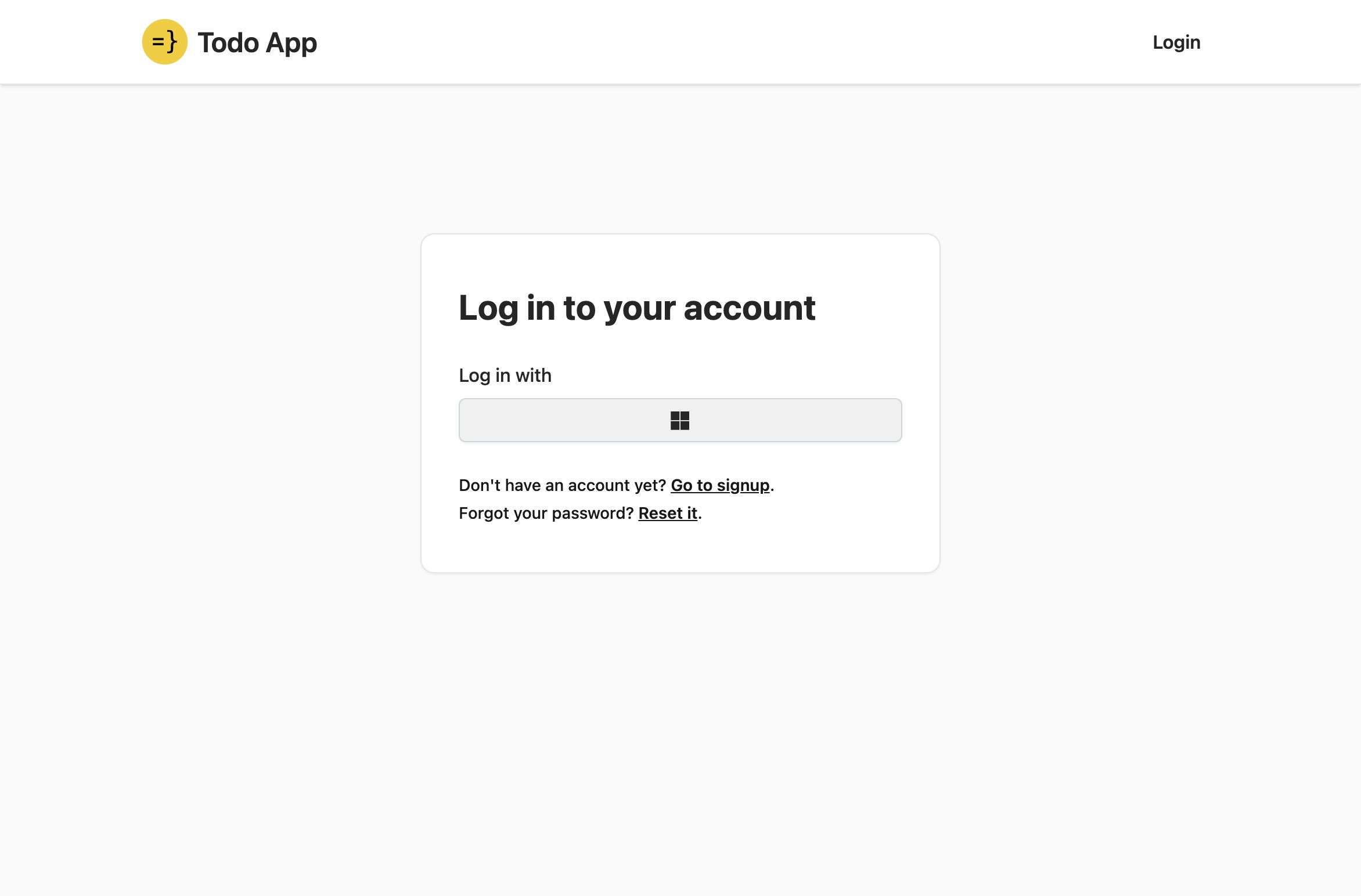
Running wasp db migrate-dev and wasp start should now give you a working app with authentication.
To see how to protect specific pages (i.e., hide them from non-authenticated users), read the docs on using auth.
Default Behaviour
Add microsoft: {} to the auth.methods object to use it with default settings:
import { app } from "@wasp.sh/spec"

export default app({
  name: "myApp",
  wasp: { version: "^0.25" },
  title: "My App",
  head: ["<link rel='icon' href='/favicon.ico' />"],
  auth: {
    userEntity: "User",
    methods: {
      microsoft: {}
    },
    onAuthFailedRedirectTo: "/login"
  },
  // ...
})
When a user signs in for the first time, Wasp creates a new user account and links it to the chosen auth provider account for future logins.
Overrides
By default, Wasp doesn't store any information it receives from the social login provider. It only stores the user's ID specific to the provider.
There are two mechanisms used for overriding the default behavior:
userSignupFieldsconfigFn
Let's explore them in more detail.
Data Received From Microsoft
We are using Microsoft's Graph API and its /oidc/userinfo endpoint to fetch the user's data.
The data received from Microsoft is an object which can contain the following fields:
{
"sub": "OLu859SGc2Sr9ZsqbkG-QbeLgJlb41KcdiPoLYNpSFA",
"name": "Mikah Ollenburg", // all names require the “profile” scope.
"family_name": " Ollenburg",
"given_name": "Mikah",
"picture": "https://graph.microsoft.com/v1.0/me/photo/$value",
}
The fields you receive depend on the scopes you request. The default scopes are set to openid, profile, and email.
For up-to-date info about the data received from Microsoft, please refer to the Microsoft Graph API documentation.
Using the Data Received From Microsoft
When a user logs in using a social login provider, the backend receives some data about the user.
Wasp lets you access this data inside the userSignupFields getters.
For example, the User entity can include a displayName field which you can set based on the details received from the provider.
Wasp also lets you customize the configuration of the providers' settings using the configFn function.
Let's use this example to show both fields in action:
import { app } from "@wasp.sh/spec"
import { getConfig, userSignupFields } from "./src/auth/microsoft" with { type: "ref" }

export default app({
  name: "myApp",
  wasp: { version: "^0.25" },
  title: "My App",
  head: ["<link rel='icon' href='/favicon.ico' />"],
  auth: {
    userEntity: "User",
    methods: {
      microsoft: {
        configFn: getConfig,
        userSignupFields
      }
    },
    onAuthFailedRedirectTo: "/login"
  },
  // ...
})
model User {
  id          Int    @id @default(autoincrement())
  username    String @unique
  displayName String
}

// ...
- JavaScript
- TypeScript
import { defineUserSignupFields } from "wasp/server/auth";

export const userSignupFields = defineUserSignupFields({
  username: () => "hardcoded-username",
  displayName: (data) => data.profile.name,
});

export function getConfig() {
  return {
    scopes: ["openid", "profile", "email"],
  };
}
import { defineUserSignupFields } from "wasp/server/auth";

export const userSignupFields = defineUserSignupFields({
  username: () => "hardcoded-username",
  displayName: (data: any) => data.profile.name,
});

export function getConfig() {
  return {
    scopes: ["openid", "profile", "email"],
  };
}
Wasp automatically generates the defineUserSignupFields function to help you correctly type your userSignupFields object.
Using Auth
To read more about how to set up the logout button and get access to the logged-in user in both client and server code, read the docs on using auth.
When you receive the user object on the client or the server, you'll be able to access the user's Microsoft ID like this:
const microsoftIdentity = user.identities.microsoft

// Microsoft User ID for example "a1b2c3d4-e5f6-7890-abcd-ef1234567890"
microsoftIdentity.id
Read more about accessing the user data in the Accessing User Data section of the docs.
API Reference
SocialAuthConfig »
All the options for the microsoft auth method.
For the provider-specific behavior of the configFn and userSignupFields functions, check the Overrides section. For behavior common to all providers, check the Social Auth Overview.